
Your Lead Started on Instagram, Closed on WhatsApp and Vanished from Your CRM?
Lead on Instagram, negotiation on WhatsApp, proposal by email — and none of those conversations talk to your CRM. See how to unify everything.
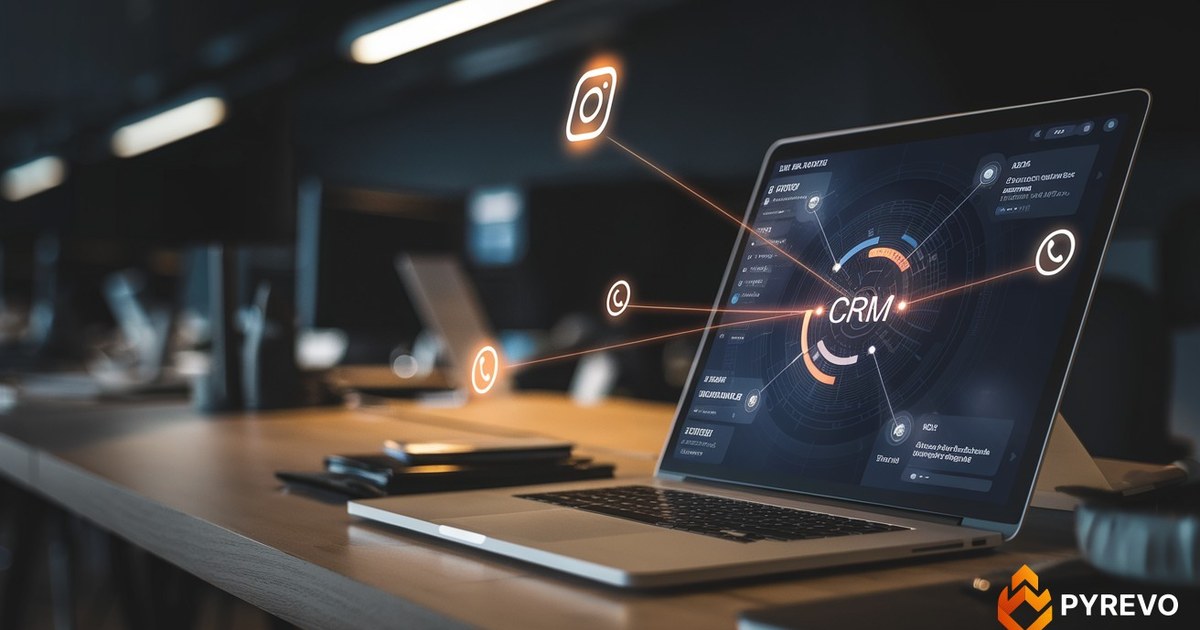
You open Instagram in the morning, reply to a DM from a potential customer, send your WhatsApp link, keep talking there, then send a proposal by email — and by end of day you have no idea what stage of the funnel that lead is in.
It's not carelessness. It's the reflection of a structural problem most B2B SMBs face: acquisition channels have multiplied, but the management infrastructure stayed the same. A notebook, a spreadsheet, or a CRM that only gets updated when someone remembers to log in.
The lead doesn't care which channel they use to talk to you. The problem is that you need to know — and you need that information in one place.
The Invisible Cost of a Fragmented Funnel
When each channel lives on an island, the cost shows up in subtle ways: the salesperson asks the lead something they already answered three days ago on Instagram; the proposal goes to the wrong email because the contact was saved under a different name on WhatsApp; or the lead simply goes cold because they fell into a gap between channels and nobody followed up.
B2B buying behavior research shows that 80% of sales require 5 or more touchpoints before closing. If those touchpoints happen across 3 different channels with no centralized record, the probability that one of them gets forgotten is extremely high.
80%
of B2B sales require 5 or more contacts before closing
3×
more likely to lose the lead when channels aren't integrated with the CRM
Why Traditional CRMs Don't Solve This
Most CRMs were built for a world of email and phone calls. The salesperson made the call, logged it in the system, and moved on. Simple, linear.
But today's B2B buyer isn't linear. They send a DM on Instagram at 10 PM, reply to a WhatsApp message during their lunch break, and request a proposal through the website chat while at the office. Each interaction happens in a different context, at a different time, with a different level of purchase intent.
Forcing that behavior into a CRM that depends on manual input is asking for the data to never be entered — or to be entered late, incomplete, and out of context.
How a Real Multichannel Funnel Works
A truly integrated multichannel funnel doesn't mean using fewer channels — it means all channels converge into a single source of truth. Every conversation, on any platform, automatically generates a record: who the lead is, what they said, what stage they're at, and when the last contact was.
In practice, the flow works like this:
- Unified capture: the lead arrives via WhatsApp, Instagram DM, Facebook Messenger, or the website chat — and is identified and logged in the CRM automatically, with no manual action required from the salesperson.
- Context preserved: when the lead switches channels (from Instagram to WhatsApp, for example), the full conversation history travels with them. The salesperson — or the AI agent — never starts from scratch.
- Funnel stage updated in real time: each interaction moves the lead to the correct stage. No spreadsheet, no sticky note, no "I think this person is somewhere in the middle of the funnel."
- Automatic follow-up triggered: if the lead stops responding on any channel, a reactivation sequence fires automatically — on the right channel, at the right time.
AI vs. Manual Management: What Actually Changes
The difference between a manually managed funnel and an AI-powered funnel isn't just speed — it's consistency. A human salesperson has good days and bad days. AI delivers the same quality response at 8 AM and at 11 PM on a Friday night.
| Funnel Stage | Manual Management | With AI Integrated into CRM |
|---|---|---|
| First contact (any channel) | Depends on salesperson being online | Response in less than 30 seconds |
| CRM logging | Manual input (often forgotten) | Automatic with every message |
| Lead switches channel | Context lost | Full history transferred |
| Follow-up after silence | Depends on memory/discipline | Automated sequence by channel |
| Pipeline report | Manually updated spreadsheet | Real-time dashboard |

What Pyrevo's Sales Engine Solves Here
Pyrevo's Sales Engine was built exactly for this problem: an AI agent that handles leads on WhatsApp, Instagram DM, Facebook Messenger, and the website chat — 24 hours a day — and automatically logs every conversation in Pyrevo Grow (CRM).
The lead doesn't need to know they're talking to an AI. They get fast, contextual responses on whatever channel they're on. And the sales manager sees, in real time, every lead, every conversation, and every funnel stage — without depending on a salesperson remembering to update a spreadsheet.
When the lead is ready to move forward, the agent hands off to a human with the full conversation history. No repetition, no lost context, no lead falling through the gap between channels.
If you want to see how this works in practice for your business model, talk to the Pyrevo team at /en/contact — the first conversation is no-commitment and can happen on whichever channel works best for you.